BPC-157 vs TB-500 is one of the most searched comparisons in peptide research. The two names appear side by side in product catalogues, forum threads and even in single blended vials, so it is easy to assume they are closely related. They are not. BPC-157 and TB-500 come from different proteins, have different structures and have been studied for different reasons. This BPC-157 vs TB-500 guide sets out seven practical differences in plain English, so you can see exactly what separates them.
Research use only. This article is educational and describes compounds sold for laboratory research. It is not medical advice, and none of the products mentioned are intended for human or veterinary use.
BPC-157 vs TB-500 at a glance
| BPC-157 | TB-500 | |
|---|---|---|
| Full name | Body Protection Compound-157 | Synthetic peptide related to thymosin beta-4 |
| Origin | Partial sequence of a protein described in gastric juice | Derived from thymosin beta-4, a protein found in most cells |
| Size | 15 amino acids | Depends on the definition used: from a short fragment up to the 43-amino-acid parent protein |
| Research themes | Mostly preclinical tissue and gastrointestinal models | Actin binding, cell migration and repair models |
| FDA status | Not approved | Not approved |
| In sport | Prohibited by WADA | Prohibited by WADA |
1. They come from different proteins
BPC-157 is a synthetic 15-amino-acid peptide. Its sequence was taken from a larger protein, named body protection compound, that researchers reported finding in gastric juice. The peptide sold today is made entirely by chemical synthesis.
TB-500 is linked to a completely different protein: thymosin beta-4 (Tβ4). Tβ4 is a small, naturally occurring protein that is present in almost every type of human and animal cell, where it binds actin – one of the main building blocks of the cell’s internal skeleton.
2. Their size and structure differ
BPC-157 has a fixed, well-defined length of 15 amino acids. TB-500 is less tightly defined. The name is used in two ways: some sources use it for a synthetic version of the full 43-amino-acid thymosin beta-4, while others use it for a short fragment containing the protein’s actin-binding region. That ambiguity is one reason to record exactly what a product’s documentation says about its sequence, rather than relying on the name alone.
3. One has a well-known natural counterpart
When comparing BPC-157 vs TB-500, the natural-counterpart question is a real difference. Thymosin beta-4 is a well-characterised protein with an extensive research literature of its own, so TB-500 sits within a larger body of work on Tβ4. BPC-157, by contrast, is mainly studied as a synthetic peptide in its own right; most of what is published concerns the 15-amino-acid fragment itself.
4. The research literature focuses on different questions
Most published BPC-157 work consists of animal and cell-culture studies, frequently using gastrointestinal and musculoskeletal tissue models. Research on thymosin beta-4 has concentrated on how it regulates actin and influences cell migration, along with studies in wound and tissue-repair models. In both cases the evidence base is overwhelmingly preclinical, and neither compound has an established, approved clinical use.
5. Neither is approved – and both are banned in sport
Neither BPC-157 nor TB-500 is approved by the U.S. Food and Drug Administration as a medicine. Both are also prohibited in competitive sport: the World Anti-Doping Agency prohibited list covers BPC-157 under non-approved substances and names TB-500 among thymosin beta-4 derivatives. Products like these are therefore sold strictly as research materials.
6. They are supplied in different ways
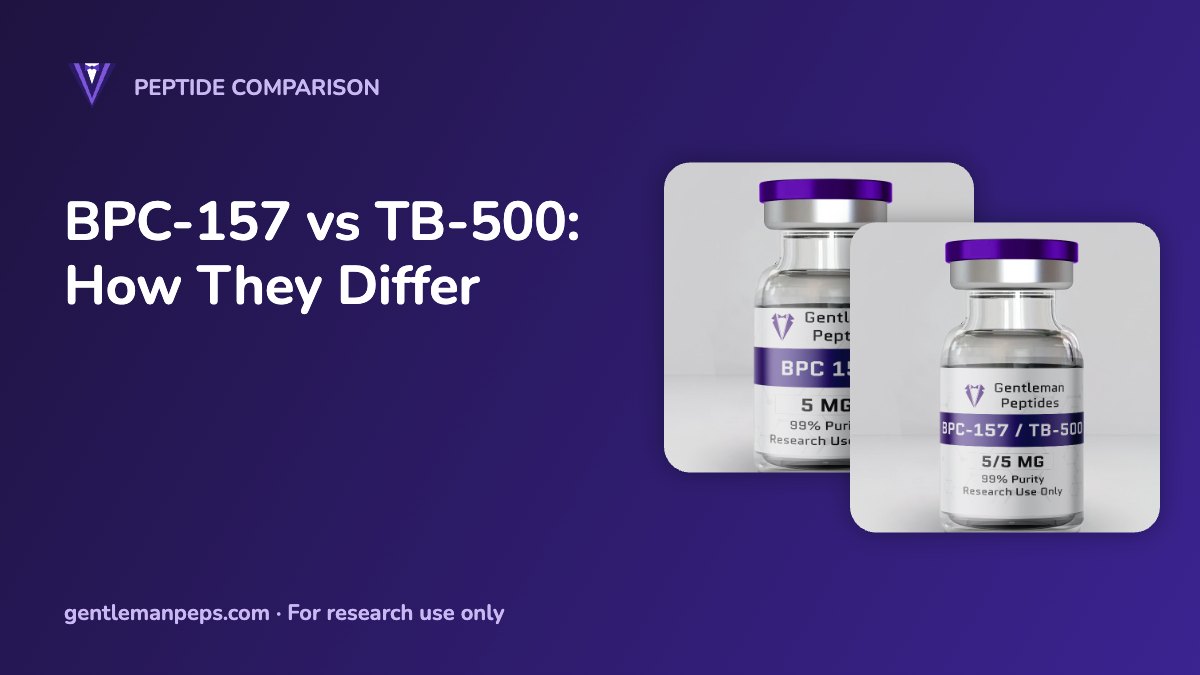
BPC-157 is widely available on its own. At Gentleman Peptides you can choose a BPC-157 5mg vial, a BPC-157 10mg vial or BPC-157 capsules (90 × 500 mcg). TB-500 is offered in combination products: the BPC-157 & TB-500 vial (5 mg of each) and the GLOW and KLOW blends, which add GHK-Cu and, in KLOW, KPV.
7. Why they are often combined
Because the two peptides are frequently studied in parallel, a pre-combined vial is a practical convenience: one container, one preparation step and a fixed 1:1 ratio by weight. The trade-off is flexibility. A blend cannot be rebalanced after manufacture, so studies that need a different ratio, or only one of the two compounds, are better served by single products.
BPC-157 vs TB-500: which should a lab choose?
The answer depends on the research question rather than on which compound is more popular. If your protocol studies BPC-157 alone, a single-peptide vial or capsule format keeps things simple. If it is designed around both peptides at equal amounts, the combination vial saves a step. If it involves GHK-Cu as well, the GLOW or KLOW blends may fit. Whichever you choose, record the full composition and labelled amounts in your notes.
You can compare every option in our peptide vials and peptide stacks categories.
Reading the BPC-157 vs TB-500 literature critically
When you read papers or articles comparing BPC-157 vs TB-500, check three things. First, was the work done in cells, animals or people? Almost all of it is preclinical, and results in animal models do not automatically carry over to other systems. Second, which molecule was actually used? For TB-500 in particular, confirm whether a study used full-length thymosin beta-4 or a fragment. Third, how was the material produced and characterised? Without identity and purity data, results are hard to interpret.
Much of what circulates online about BPC-157 vs TB-500 is anecdotal or promotional rather than peer-reviewed. Treat claims that go beyond the published preclinical evidence with caution, and prefer primary sources over summaries.
Recording BPC-157 vs TB-500 work in the lab
If your laboratory works with both peptides, a few habits prevent confusion. Store single-peptide and combination vials separately, record the exact product name and labelled amounts, and note whether a blend was used. When writing up a BPC-157 vs TB-500 comparison, state the source, amount, format and batch information for each compound so that others can reproduce the work.
Frequently asked questions
Is TB-500 the same as thymosin beta-4?
Not always. The name TB-500 is used both for a synthetic version of thymosin beta-4 and for a shorter fragment of it, so the exact definition depends on the supplier’s documentation.
Are BPC-157 and TB-500 related?
No. They are derived from different proteins and have different structures. They are grouped together because they are often studied side by side.
Can I buy BPC-157 and TB-500 in one vial?
Yes. The BPC-157 & TB-500 vial contains 5 mg of each, as stated on the label.
Further reading: BPC-157 on Wikipedia.