CJC-1295 with DAC vs without DAC is a question that confuses many people new to peptide research, because both products are commonly sold as “CJC-1295”. They share the same core peptide sequence, but one carries an extra chemical group that changes how long it persists in a biological system. Mixing them up can make a study’s results impossible to interpret. This guide explains what the DAC is, how the two forms differ and how to tell them apart on a label.
Research use only. This article is educational and describes compounds sold for laboratory research. It is not medical advice, and none of the products mentioned are intended for human or veterinary use.
What is CJC-1295?
CJC-1295 is a synthetic analogue of growth hormone-releasing hormone (GHRH), developed by the Canadian company ConjuChem. It is based on the first 29 amino acids of GHRH – the part of the hormone needed for its activity – with four amino-acid substitutions. Those substitutions make the peptide more resistant to the enzymes that quickly break down natural GHRH.
What does DAC stand for?
DAC stands for Drug Affinity Complex. In CJC-1295 with DAC, a reactive chemical linker is attached to a lysine residue at the end of the peptide. Once the peptide is in the bloodstream, this linker forms a covalent bond with serum albumin, the most abundant protein in blood plasma. Because albumin circulates for a long time, the attached peptide does too.
CJC-1295 with DAC vs without: the key differences
| CJC-1295 with DAC | CJC-1295 without DAC | |
|---|---|---|
| Also known as | CJC-1295 DAC | Modified GRF (1–29), Mod GRF 1-29 |
| Core sequence | Modified GHRH (1–29) | Modified GHRH (1–29) |
| Albumin-binding group | Yes | No |
| Persistence | Long – binding to albumin greatly extends half-life | Short – cleared much faster |
| At Gentleman Peptides | CJC-1295 with DAC 5 mg vial | In the CJC / Ipamorelin blend |
Half-life and persistence
The single most important difference is persistence. Published human studies of CJC-1295 with DAC reported a half-life measured in days rather than minutes, which is a direct consequence of albumin binding. The no-DAC form lacks that anchor, so it is cleared far more quickly. That difference is why the two forms cannot be substituted for each other in a study.
Naming
The naming is the main source of confusion. Strictly, “CJC-1295” referred to the DAC-modified compound, while the unmodified analogue is better described as modified GRF (1–29). In practice, many suppliers use “CJC-1295 no DAC” for the latter. Whenever you see the name, check for the words “with DAC” or “no DAC”.
How to tell them apart on a label
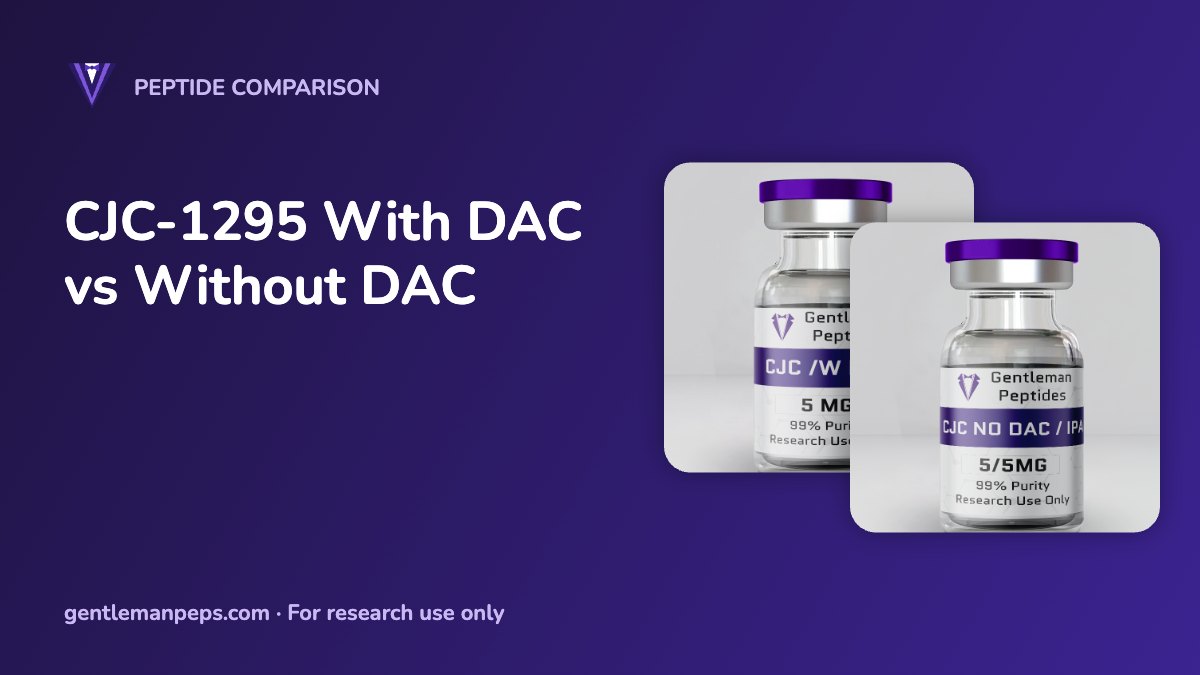
At Gentleman Peptides the two forms are labelled clearly. The single-peptide vial reads “CJC /W DAC 5 MG”, while the combination vial reads “CJC NO DAC / IPA 5/5MG” – the no-DAC form plus Ipamorelin. If you work with both, store them separately and write the full name, including the DAC status, in your laboratory records.
Why is the no-DAC form usually paired with Ipamorelin?
CJC-1295 and Ipamorelin act on different receptors. CJC-1295 acts on the GHRH receptor, while Ipamorelin is a pentapeptide that acts on the ghrelin receptor. Researchers interested in both pathways often study them together, and the short-acting no-DAC form is the version most commonly combined. The CJC / Ipamorelin vial supplies 5 mg of each in one container.
Regulatory status
Neither form of CJC-1295 is approved by the FDA as a medicine, and both are sold as research materials only. Peptides acting on growth hormone pathways are also prohibited in competitive sport.
Which form should a lab choose?
Choose based on the persistence your study design requires. For long-acting, albumin-bound material, use CJC-1295 with DAC. For short-acting material, or for a study built around a fixed combination with Ipamorelin, use the blend. Browse both in our peptide vials and peptide stacks ranges.
CJC-1295 with DAC vs without in study design
The choice between CJC-1295 with DAC vs without DAC usually follows from the time course a study needs. Because the DAC form persists for days, it suits designs that examine sustained exposure; the no-DAC form, cleared quickly, suits designs that examine short pulses. Mixing data from the two forms, or switching forms partway through a project, makes results hard to compare.
The difference also matters for analysis. The DAC form has a higher molecular weight than the unmodified peptide because of the added linker, so identity testing by mass spectrometry gives a different result for each. Make sure the documentation you hold matches the form you ordered.
Common mistakes with CJC-1295 with DAC vs without
- Assuming every product named “CJC-1295” includes DAC.
- Recording only “CJC-1295” in laboratory notes, without the DAC status.
- Comparing amounts between the two forms by weight alone, ignoring the extra mass of the DAC linker.
- Storing both forms together in unlabelled secondary containers.
A clear label and a consistent naming convention avoid every one of these problems. When in doubt about CJC-1295 with DAC vs without DAC, check the label and the product documentation before use.
Frequently asked questions
Is Mod GRF 1-29 the same as CJC-1295 without DAC?
Yes. The two names are generally used for the same modified GHRH (1–29) peptide without the albumin-binding group.
Does DAC change the peptide sequence?
The core sequence is the same. DAC adds a chemical linker to a lysine residue so that the peptide can bind to albumin.
Can I buy CJC-1295 without DAC on its own?
At Gentleman Peptides, the no-DAC form is currently supplied only in the CJC / Ipamorelin blend.