Ipamorelin vs MK-677 is a comparison between two compounds that do the same job at a receptor level but could hardly be more different chemically. Both are growth hormone secretagogues that act on the ghrelin receptor. Ipamorelin, however, is a short peptide, while MK-677 – ibutamoren – is a small non-peptide molecule. That single difference shapes how each is made, supplied, stored and studied. Here are six key differences.
Research use only. This article is educational and describes compounds sold for laboratory research. It is not medical advice, and none of the products mentioned are intended for human or veterinary use.
Ipamorelin vs MK-677 at a glance
| Ipamorelin | MK-677 (ibutamoren) | |
|---|---|---|
| Type of molecule | Pentapeptide (5 amino acids) | Non-peptide small molecule |
| Target | Ghrelin receptor (GHS-R1a) | Ghrelin receptor (GHS-R1a) |
| Developed by | Novo Nordisk (1990s) | Merck (1990s) |
| Typical research format | Lyophilised vial | Capsules or solution |
| FDA approval | Not approved | Not approved |
1. One is a peptide, the other is not
Ipamorelin is a chain of five amino acids, including two non-natural D-amino acids and a modified amino acid that improve its stability. MK-677 is a spiropiperidine small molecule with no peptide bonds at all. This is the most important point in any Ipamorelin vs MK-677 comparison, because it explains most of the other differences.
2. They act on the same receptor
Despite their different structures, both compounds are agonists of the growth hormone secretagogue receptor (GHS-R1a), the receptor through which the hormone ghrelin acts. Pharmacologists call compounds like these “ghrelin mimetics”. Reaching the same target with such different molecules is a good illustration of how receptor binding depends on shape and chemistry rather than molecule type.
3. Different origins
Ipamorelin emerged from Novo Nordisk’s work on growth hormone-releasing peptides in the 1990s and is often described as one of the more selective members of that family. Ibutamoren was developed by Merck in the same decade as an orally active compound – MK-677 is its Merck development code. Both reached human clinical trials; neither has been approved as a medicine.
4. They are supplied in different formats
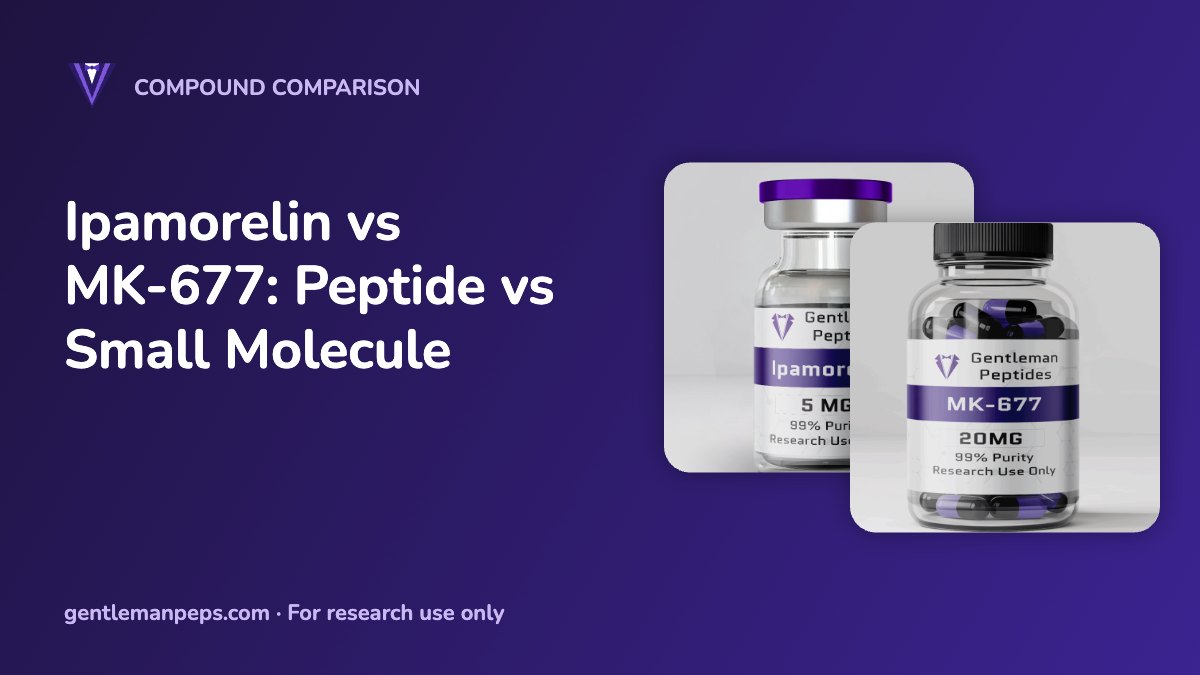
As a peptide, Ipamorelin is supplied as a lyophilised powder in a sealed vial, like most research peptides. Ibutamoren, as a small molecule, does not need freeze-drying, so it is commonly supplied in pre-measured capsules or as a solution. When weighing Ipamorelin vs MK-677 for a study, format is often a practical deciding factor.
5. Handling and stability
Lyophilised peptides like Ipamorelin are generally stored cold and dry, then prepared in the laboratory when needed; once in solution they become more fragile. Small molecules such as ibutamoren are typically more tolerant of handling, but should still be kept cool, dry and away from light. Our guide on how to store peptides covers storage by format.
6. Regulatory status
Neither compound is approved by the FDA as a medicine. The FDA’s list of bulk drug substances that may present significant safety risks in compounding includes both ipamorelin acetate and ibutamoren mesylate. Growth hormone secretagogues are also prohibited in competitive sport under the World Anti-Doping Agency’s rules. Both are sold strictly as research materials.
A note on selectivity
Ipamorelin is frequently described as “selective” because early animal studies reported that it stimulated growth hormone release without the marked rises in other hormones, such as ACTH and cortisol, seen with some earlier growth hormone-releasing peptides. That description comes from preclinical work and should be read in that context. For ibutamoren, the literature is dominated by its oral activity and long duration of action rather than by selectivity comparisons.
What the published research covers
Ibutamoren has been evaluated in a number of human clinical trials since the 1990s, including studies in older adults and a trial in Alzheimer’s disease that did not show a benefit. None led to an approved medicine. Ipamorelin reached clinical trials too, including investigation for post-operative gut motility, but also was not approved. When reviewing Ipamorelin vs MK-677 literature, separate preclinical findings from clinical ones and note which formulation was used.
Choosing between Ipamorelin vs MK-677 for a laboratory study
The choice usually comes down to three practical questions. Does the study need a peptide specifically, for example to compare with other peptides? Is a powder that is prepared in the laboratory acceptable, or are pre-measured capsules or a solution more convenient? And does the protocol pair the secretagogue with a GHRH analogue such as CJC-1295, where Ipamorelin is the conventional partner? Answering those questions narrows the choice quickly.
Ipamorelin vs MK-677 in study design
Because the two act on the same receptor, they are sometimes used to compare how a peptide and a small molecule behave at a shared target. In that kind of work, the Ipamorelin vs MK-677 contrast is the whole point, so record both compounds’ format, amount and source carefully. Where a study combines a secretagogue with a GHRH analogue, Ipamorelin is the compound usually paired with CJC-1295 – see our CJC-1295 with DAC vs without explainer and the CJC / Ipamorelin vial.
Frequently asked questions
Is MK-677 a peptide?
No. MK-677 (ibutamoren) is a non-peptide small molecule, even though it is often sold alongside peptides.
Do Ipamorelin and MK-677 work on the same receptor?
Yes. Both are agonists of the ghrelin receptor, GHS-R1a.
Which formats are available at Gentleman Peptides?
Ipamorelin is available as a 5 mg lyophilised vial; MK-677 is available as capsules labelled 20 mg and as a 30 mL liquid.